



With Appeal Judgment on Vojislav Šešelj, Justice is Partially Achieved
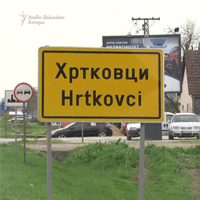
On April 11 2018, the Appeals Chamber of the Mechanism for International Criminal Tribunals (MICT) in The Hague passed sentence with its final verdict on the President of the Serbian Radical Party (SRS), Vojislav Šešelj, and reversed his acquittal by the International Criminal Tribunal for the former Yugoslavia Trial Chamber, sentencing him to 10 years of imprisonment for encouraging persecution (forced displacement), deportation, and other inhumane acts (forcible transfer), as crimes against humanity, and for committing persecutions in Hrtkovci in Vojvodina (violations of the right to security) as a crime against humanity. The Humanitarian Law Center (HLC) considers such a judgement significant, since in this way the victims of deportation and persecution in Hrtkovci almost 26 years ago have received judicial satisfaction; however, justice has only been partially satisfied, given the scope of the indictment against Šešelj, which encompasses the area of Sarajevo, as well as the municipalities of Zvornik, Nevesinje and Mostar in BiH, and Vukovar in Croatia.


 On Monday, March 12, 2018, the Office of the War Crimes Prosecutor (OWCP) presented the Draft Prosecutorial Strategy for the Investigation and Prosecution of War Crimes in the Republic of Serbia for the period 2018-2023 (Draft), in accordance with the obligations of the
 The Humanitarian Law Center (HLC) and the Humanitarian Law Center Kosovo published in 2014 the list of individuals who died as a consequence of NATO bombing of the Former Republic of Yugoslavia. According to this

 On March 2 2018, the Humanitarian Law Center (HLC) submitted a criminal complaint against Svetozar Andrić, former commander of the Birač Brigade of the Republika Srpska Army (VRS), and later Chief of Staff of the VRS Drina Corps, to the War Crimes Prosecutor’s Office of the Republic of Serbia. The criminal complaint was filed for several crimes committed during the conflict in Bosnia and Herzegovina (BiH).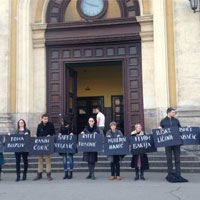


 After 14 years, the first war crimes case before specialized court councils in Serbia came to a close with the new