



The Commissioner for Human Rights: Resolving the fate of missing persons should be priority for governments
 The Council of Europe Commissioner for Human Rights announced on February 22nd, 2017 a report titled “Missing Persons and Victims of Enforced Disappearance in Europe”, which summarizes the findings and recommendations for improving the search for missing persons and the protection of rights of victims of enforced disappearances in the member states of the Council of Europe (CoE). The report ensued after a roundtable with human rights defenders held in mid-2016 in Strasbourg and attended by the representatives of the CoE, the UN Special Rapporteur on Human Rights Defenders, a member of the UN Working Group on Enforced or Involuntary Disappearances and human rights defenders from the member states of the CoE, including the Humanitarian Law Center. The aim of the meeting was to exchange information on the situation in European countries affected by the problem of missing persons, based on the findings and recommendations of the Commissioner in March 2016.

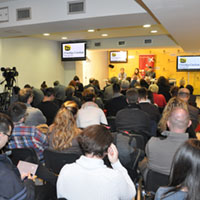
 On Tuesday, January 31st, 2017, the HLC presented its eighth dossier in a row about unprosecuted crimes and possiblel perpetrators. The Dossier “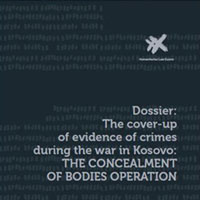
 Since 2001, mass graves containing the bodies of 941 Kosovo Albanians, mainly civilians killed outside combat situations in Kosovo during 1999, have been found on four locations in Serbia. 744 bodies of Kosovo Albanians have been discovered in Batajnica, on the outskirts of Belgrade, at least 61 in Petrovo Selo, and 84 at Lake Perućac. At least 52 bodies have been subsequently found in the mass grave at Rudnica.
 With regard to the announced appearance of a war criminal, Veselin Šljivančanin, at a Serbian Progressive Party rally, civil society organizations demand that the ruling political parties stop putting the match to nationalism as electoral fuel, and establish responsibility for preserving and improving peace in the region as their first priority.
 On December 22nd, 2016, the Humanitarian Law Center (HLC) presented its sixth dossier in a row on possible perpetrators of war crimes committed during the armed conflicts in the former Yugoslavia. The “
 After capturing Žepa in late July 1995 approximately 800 Bosniaks from Žepa crossed the River Drina and entered the territory of the Republic of Serbia, frightened for their lives after rumours had spread of the crimes committed by the Army of Republika Srpska in Srebrenica. Most of them were members of the Army of BiH, but there were also civilians, including dozens of underage boys. Almost immediately after crossing, the men were taken captive by border guards of the Yugoslav Army and members of Special Police Units.
 Following the presentations in Zagreb and Sarajevo, the results from the list of human losses during the armed conflicts in Croatia, Kosovo, and partially in Bosnia and Herzegovina (BiH), as well as the list of detention sites in the armed conflict in BiH, were presented in Belgrade on December 15th, 2016. According to the research in progress, 13,535 persons were either killed or disappeared during the war in Kosovo, and 2,057 citizens of Serbia and Montenegro were killed or disappeared during the wars in Croatia and BiH, whereas approximately 160,000 citizens of BiH were detained in camps set up throughout the territory of that country.