



Call for Applications: Memory Activism Fellowship – Deadline: 1 October
 Since 1992, Humanitarian Law Center has worked on documenting war crimes and human rights violations committed in the former Yugoslavia, focusing on the victims and their stories. The organisation advocates for a comprehensive and multifaceted transitional justice process. The work of the HLC is based on three pillars: documentation, justice and memory, with the Memory Activism Program as central for the organisation’s future. With its Memory Activism Program, the Humanitarian Law Center commemorates victims through various initiatives, including public debates, documentary films and digital memory activism on social media and other digital memory practices. In addition to commemorating victims of war crimes and mass human rights violations during the 1990s wars, the Memory Program challenges and confronts the dominant revisionist narratives about the wars, provides informal education, disseminates the judicially determined facts about the wars engagingly, using different media formats. Furthermore, the program conducts policy-oriented research and analysis and commentary of official memory politics in the region.

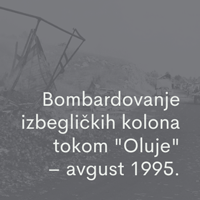
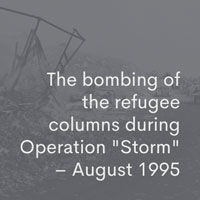 In order to establish the facts about the bombing of refugee columns on the territory of Bosnia and Herzegovina during the Croatian military-police Operation “Storm”, the Humanitarian Law Center (HLC) is publishing the data and excerpts from the witness statements about those events, which it collected immediately after the refugees’ arrival in Serbia.
 The Report includes an analysis of 26 cases monitored by the HLC before the war crimes departments of the Higher Court and the Court of Appeals in Belgrade. Also, the Report contains an overview of the general findings on war crimes trials during 2021, as well as important socio-political events that are vital for war crimes trials in Serbia.
 The Humanitarian Law Center (HLC) will present the Report on War Crimes Trials in Serbia during 2021 on Friday, May 6, 2022, at 11:00 AM. The presentation will take place in the Main Conference Hall of the Media Centre in Belgrade (Terazije 3, 2nd floor).

 In Serbia’s public discourse, the dominant interpretations on the Yugoslav wars not only ignore or devalue judicially-established facts about crimes committed during the wars, but deny and falsify the facts into distorted narratives. Media work in a context of increasing monopolisation by revisionist memory politics from above. At the same time, media themselves are becoming a crucial instrument in revisionist memory politics.
 Following June 1999 the Serbs in Kosovo have been having a hard time. After the withdrawal of the Serbian army and the police, they became the targets for the KLA and criminal groups. Numerous murders, abductions and property destruction happened in the presence of the international forces. The absence of KFOR’s reaction persuaded even those Albanians who were against the violence that the international community was supporting the idea of the extreme political groups that Kosovo should be free of the Serbs. On 17 March, with the exception of Mitrovicë/Mitrovica, UNMIK and KFOR, once again and primarily through their omission to act, encouraged the Albanian extremists.
 The Humanitarian Law Center accepts applications for the first round of Memory Activism Fellowships, including two fellowships of up to 6 months, starting in May and October 2022. We welcome fellowship applications from researchers, journalists, practitioners and artists who work on the 1990s wars in former Yugoslavia from different perspectives. The fellowship is non-residential and does not require a presence in Belgrade. During the fellowship, the fellows are expected to generate outputs that will be published and promoted by the HLC. The outputs can be in the form of analysis, a report, a series of blogs or organisation of events.